Cooler Conditions Throughout the Week

While this summer has been an unusual one in terms of how much rain we have received, we have also been the victims of another very hot summer. Temperatures consistently in the mid to upper 90s making life miserable for those who don’t like the extreme heat.

After this past weekend’s storms temperatures have dropped significantly to much of the content of everyone. I remember after walking outside right after the storm and it was very cool in comparison to the heat from earlier in the day. I checked the KY Mesonet and it had recorded a maximum temperature for Saturday at 92 degrees fahrenheit. Right after the storm had passed it was reading 72 degrees. A 20 degree drop in just a few hours.

Current Weather Map Highs and Lows from NOAA

Current Weather Map -NOAA

Mild temperatures are coming from the passing cold front that brought the weekend storms. With another cold front to our north west that will effect us closer this weekend, we are expierencing high pressure with clear skies all around.

If the low pressure area on the east side of the Rocky Mountains maintains its momentum and direction, it will have an effect on us later in the week. However, as of now we will just have to enjoy sunny skies and mild temperatures. Can fall get here soon enough?

Tonight: Expect a low around 65 degrees and clear night skies.

Tomorrow: Will be much like today was with a high in the mid to upper 80s with clear to partly cloudy skies.

As this is my first blog post I will have some improvements to make, I would like to introduce myself. My name is Austin Evans and I am a junior Meteorology student at Western Kentucky University. I have a minor in Broadcasting and hope to make weather my full time career. I will see you Wednesday!


Posted in Kentucky Weather | Comments Off on Cooler Conditions Throughout the Week

Weekend Outlook

The weather for this weekend will be influenced by a low pressure system, which will be moving to our north near the Great Lakes. This system will bring a cold front over our region, giving us chance at rain and thunderstorms throughout today and tomorrow. By Sunday morning, we should again be seeing sunny skies, which look to last until Tuesday. We will also see a drop in temperature as a result of this system, making way for cooler temperatures on Sunday and the early part of next week.

Surface Map

NWS Surface map issued for Sept 9th at 3:42 AM local time.

Today

As the low pressure system moves toward our north, there is a 20% chance of scattered showers today. However most of the rain looks to remain just north of us, affecting Indiana and Lexington. We will be experiencing winds between 5-10 mph from our Southwest, and the temperature today will continue the pattern of the past few days, with a high of 90 and low of 70.

Saturday

The cold front will begin moving across our region in late morning Saturday, bringing some slightly cooler temperatures and a 50% chance for rain and thunderstorms. Rain will remain a possibility throughout the day, with a 30% chance until around 8pm. Winds will continue from the Southwest at 6-11 mph, but gusts up to 20 mph are expected. The temperature will fall slightly into the upper 80’s as the high, and a low of a cooler high 50’s.

Sunday

The cold front will have moved out of our area by late Saturday night, making for great weather on Sunday. The skies will remain clear throughout the day, and we’ll finally get some relief from high temperatures. Winds will shift to be blowing from the Northeast at 3-7 mph. The high for Sunday will be at a comfortable 78 degrees, and a low in the mid 50’s.

Posted in Kentucky Weather | Comments Off on Weekend Outlook

WKU Meteorology Program Expands

Over the past several months the Meteorology program at WKU has expanded technological capabilities through grant funding under the diligence of Dr. Josh Durkee and Dr. Eric Rappin. This award went to purchase computer systems, servers, and software upgrades which allowed for the installation of AWIPSII, a highly sophisticated atmospheric analysis and visualization software program created by Unidata. This software is used by the National Weather Service and functions on many different levels between simple surface observations, radar and satellite data, lightning data, and numerical weather prediction analysis. This will enable the WKU meteorology program to offer hands-on training and experience to student looking to enter a very competitive work force upon graduation.

chaos-logo-lightning

CHAOS Logo

The new platform is housed under the newly coined College Heights Atmospheric Observatory for Students, or CHAOS Meteorology Lab. As a result, its drawing more and more attention to the program, as well as from the National Weather Service in Louisville who is offering seminars to the program in order to gain better understanding to the software’s capabilities.

Over the spring semester, Lead Forecaster Mark Jarvis (NWS Louisville) gave a presentation on AWIPSII to several student within the program:


A full article courtesy of Dr. Durkee via Unidata’s website can be seen through link here.

An article by WKU News featuring the AWIPSII upgrade can be seen here.

In addition to this expansion it is noteworthy to mention that the meteorology programs freshman level attendance has nearly tripled over the past eight years. In response the higher demands within the program, logistical changes are being made to add another CHAOS lab to furnish more workstations to facilitate the higher number of students. Also, WKU’s Geographic Information Science (GIS) program is now planning to move next door in the EST building. This is a move to allow for the two programs to work more efficiently together and provide more GIS training to meteorology students. Currently the Fall  2016 semester has over 290 students utilizing the CHAOS Lab for their Meteorology 121 class.

In addition to all of the recent technological upgrades to the program, Dr. Josh Durkee has launched a WKU centralized weather information and forecasting service to serve the needs of campus activities for students, and more, called White Squirrel Weather (WSWX for short). This is an exciting new venture for the meteorology pr gram as students and faculty will combine the talents and capabilities of each individual to provide custom weather information for WKU’s needs which include NCAA sporting activites, as well as providing forecasts and consulting during severe weather and winter storms.

WSWX Logo

WSWX Logo

Currently WSWX is working to launch their new website and will be available in the next few weeks for anyone interested in seeing a WKU focused weather information platform, which includes on-site weather observation data at EST, and soon to be available at WKU’s Houchens Industries–L. T. Smith Stadium, with future stations also possible.

Follow along as CHAOS and White Squirrel Weather continues to expand, along with the program in general!  Social media is a quick way to stay updated and get involved!

  • Twitter:
    • @WKUweather (WSWX)
    • @wkuCHAOS (WKU Meteorology)
    • @wkustormteam (WKU Storm Team)
    • @WarrenCountyWX (WKU StormToppers)
    • @wkustormchase (Self explanatory)
Posted in Kentucky Weather | Comments Off on WKU Meteorology Program Expands

Cooler, Dryer Weather For Ohio Valley | Tropics Heat Up

Not surprisingly, changes in the weather are taking place this week across the country and Kentucky is in full participation. With the onset of September finally here, climatic changes usually start to show in our day-to-day weather and this is certainly the case. A persistent ridge of high pressure over much of the eastern portion of the United States is finally taking a few days off which will allow for cooler, dryer air to infiltrate the region from the north. This is just in time for WKU football as we host Rice on Thursday September 1st at 7:00 PM at Houchens-Smith Stadium.

Guidance suggests the changeover to a more comfortable air mass on Thursday as a positively tilted trough approaches from the Great Lakes region throughout the day. Below is the NAM depicting the trough and other important weather features (see Gulf of Mexico):

500 hPa map valid for Thursday at 7:00 PM.

500 hPa map valid for Thursday at 7:00 PM.

It appears the full effects of the cold front won’t be felt until later into the afternoon hours when noticeably dryer air moves into western KY. The passage of the front is not expected to bring rainfall however, WPC forecasts also support this notion:

WPC QPF forecast

WPC QPF forecast valid thru 00 UTC Friday 2 September

However, as we start to feel some relief from the hot and humid conditions that have been the apparent theme for summer weather in the Ohio Valley, tropical weather activity across the Atlantic basin is starting to increase:

two_atl_2d0

  • As seen above, the NHC is currently tracking and issuing Atlantic advisories for:
  1. Tropical Depression 8
  2. Tropical Storm Hermine
  3. Hurricane Gaston

Currently, Tropical Storm Hermine is situated in the Gulf of Mexico and is expected to continue a period of strengthening before making landfall somewhere in the Florida panhandle. Primary threats from the system, and most tropical storms alike, are heavy rain producing thunderstorms and storm surge.

This tropical system will need to be watched in the coming days as it moves northeastward along the Atlantic coast and interacts with the same trough affecting our weather here in KY. Below is the latest NHC forecast track:

NHC forecast cone for Tropical Storm Hermine

NHC forecast cone for Tropical Storm Hermine

Any significant interaction with the upper-level trough along the east coast would mean a heavy rainfall threat from Georgia to Massachusetts. The Weather Prediction Center and National Hurricane Center will continue to track the developing system in the coming days.

In the mean time, more comfortable weather conditions for us here in Bowling Green and the surrounding areas will extend throughout the weekend with no noteworthy chances of precipitation to boot. Warmer weather and the return of higher dewpoints look to begin returning by the start of the next work week, but overall, the next several days look sunny and dry.

In other news, changes and new implementations are taking place within the WKU meteorology program and the Department of Geography and Geology. I’ll discuss these topics on Friday!

Posted in Kentucky Weather, U.S. Weather | 1 Comment

Anomalous Precipitation Across Western KY

This summer has certainly been hot and humid across much of the commonwealth, we can all agree. For the most part, upper-tropospheric ridging near the Ohio Valley and eastern seaboard has been primarily responsible for the warm temperatures and humid air mass across Kentucky and much of the central US. As a result, typical jet-stream placement has been well to our north, depriving upper-level flow of wind energy necessary to help move out these muggy conditions. Not surprisingly this favored several convective precipitation events which took place throughout the summer months and several of which were documented by our own Kentucky Mesonet observation sites.

July in particular was very active with heavy thunderstorm activity across western KY. Many KY Mesonet stations observed 5″+ of rain on different occasions, examples below:


July ended up being the wettest month on record for Bowling Green with heaviest precipitation on the 6th and 28th. Here are some figures courtesy of the NWS in Louisville which help support the notion of a warm and humid July.


Average Temperature Departure from Normal Rain Departure from Normal
Bowling Green 81.1° +2.4° 11.12″ +7.02″
Frankfort 78.3° +2.0° 7.61″ +3.22″
Lexington 78.3° +2.1° 4.98″ +0.33″
Louisville Bowman 79.9° +2.1° 4.73″ +0.56″
Louisville International 80.8° +1.5° 4.65″ +0.42″
  • Records Set:
  1. July 5th: Record warm low of 76° at Bowling Green
  2. July 13th:  Record warm low of 76° at Bowling Green
  3. July 24th: Record warm low of 74° at Frankfort
  4. July 28th: Record rainfall of 2.47″ at Frankfort
  5. Wettest July ever recorded in Bowling Green with 11.12″


This image from the Climate Prediction Center helps show the spatial extent of anomalous precipitation that affected western KY and surrounding regions during the past 90 days.

This image from the Climate Prediction Center helps show the spatial extent of anomalous precipitation that affected western KY and surrounding regions during the past 90 days.

As for now, the preliminary August climate data for Bowling Green is sitting at:

  • Avg temperature: 80.4 degrees
  • Departure: +2.8 degrees
  • Monthly precipitation: 5.16″
  • Departure: +2.19″

Currently we’re still experiencing upper-level ridging and a warm, humid air mass such as that of the past several weeks. However, model guidance is suggesting a break in the muggy conditions towards the end of the week as a trough is expected to approach the Ohio Valley from the north. Below depicts the current ridge of high pressure across the eastern US followed by the trough axis which will bring relief Thursday – Saturday this week, perfect timing for football. Go Tops!

GFS 300 hPa map valid for today at 1200 UTC

GFS 300 hPa map valid for today at 1200 UTC

GFS 300 hPa map valid for Thursday at 1200 UTC

GFS 300 hPa map valid for Thursday at 1200 UTC

With this expected change in a rather stagnant upper-level pattern for our region, afternoon highs of mid to low 90s will instead be in the mid to low 80s with noticeably lower values of dewpoints/relative humidity across the Commonwealth. This may be the start to a much welcome break in weather conditions and a good start to September.

Stay tuned to the Meteorology blog this week for some other exciting news with regards to activity going on within the program!


Posted in Kentucky Weather | 1 Comment

WKU Storm Chase 2016 – Day 13

Today's route map. An interactive version is available below

Today’s route map. An interactive version is available below

Before our morning forecast discussion, Flavia Moraes presented her thesis defense on mesoscale convective complexes in southern Brazil (Figure 1). She did a fantastic job presenting incredibly interesting research on how these complexes form and what conditions they form under; in near perfect English to boot! We’d all like to congratulate her on a job well done!

Figure 1: Flavia Moraes presents her thesis defense to the WKU Storm Chasers

Figure 1: Flavia Moraes presents her thesis defense to the WKU Storm Chasers

Our morning forecast discussion and target selection was completely student-based; a first for our trip. We identified a weakening surface low in western Kansas that provided an anchor for a dryline that would drape southward through central Kansas and into western Oklahoma and eastern Texas. This low also provided anchorage for a stationary boundary that stretched west to east near the Kansas-Nebraska state line. The existence of this northern boundary provided an area of moisture convergence in north central Kansas, and wind shear along the boundary was more favorable for more developed supercells, as opposed to further south where more multicellular and messy formations were expected. We targeted Salina, KS for lunch and further analysis, since the warm front target was better sheared, and departed around 12 PM CST.

We had lunch at Schlotsky’s in Salina and performed a model data analysis shortly after. Shear profiles across the region were the most interesting to us. The southern target area in Oklahoma showed indications of having a more westerly component to the upper-level shear and the northern target had a more easterly component of low-level shear. This made bulk effective shear values very similar for both targets. A decision had to be made. Due to the fact that convection had fired early over the southern target, using up most of the CAPE present a stabilizing the atmosphere, and due to the fact that the northern target’s shear profile was expected to improve over time, we selected to stick with our northern target. We proceeded to a park in Salina to await initiation.

Initiation occurred across the northern boundary at around 3:30 PM CST. We moved north to intercept and monitored cells to chase along the way. Three independent supercells blossomed ahead of us near Bellville, KS, one to the east, north, and west, and each of these cells had their own wall clouds. Upon arrival in Belleville, the northern cell split and the right moving cell dropped a very lowered, slowly rotating wall cloud that showed promise (Figure 2). We moved to intercept and stepped out of the car. Our heads spinning in every direction to monitor all three wall clouds surrounding us for signs of tornado development, we noticed that the northern right-split storm began dropping a very thin, ropy funnel (Figure 3) before losing the lowered wall cloud and dissipating. The storm to our west looked more promising than to the east, so we moved to intercept that storm.

Figure 2: A rotating wall cloud forms under the Belleville cell.

Figure 2: A rotating wall cloud forms under the Belleville cell.

Figure 2: A thin, ropy funnel descends from a rotating wall cloud in Belleville, KS

Figure 3: A thin, ropy funnel descends from a rotating wall cloud in Belleville, KS

Again, the storm lowered a slowly rotating wall cloud (Figure 4) but never dropped a visible funnel. We chased the storm just over the Nebraska state line before the storm became stationary and slowly lost rotation. We began to head back home, but the stationary storms to our right produced some stellar photography opportunities (Figures 5 and 6).

Figure 4: The second cell to our west drops a rotating wall cloud

Figure 4: The second cell to our west drops a rotating wall cloud

Figure 5: A whale's mouth cloud from the western stationary storm near Belleville, KS

Figure 5: A whale’s mouth cloud from the western stationary storm near Belleville, KS

Figure 6: Roiling clouds above Belleville, KS

Figure 6: Roiling clouds above Belleville, KS

Today was our final chase day of the trip, since tomorrow’s target area is out of range for us from our starting point in Salina. We will proceed tomorrow to St. Louis to stay the night and head home Sunday morning. This chasing experience has been a milestone event in my academic and personal lives, and the friends I’ve made and the natural beauty I’ve witnessed will never be forgotten. I would like to thank both Drs. Durkee and Dixon for leading the charge and teaching us more than we would have ever learned in a classroom environment. I’d also like to thank WKU for supporting this incredible program and providing an amazing opportunity for our department’s members.

-Isaac Bowers

Click this link for an interactive chase map!

Posted in U.S. Weather | Tagged , , , , , , | Comments Off on WKU Storm Chase 2016 – Day 13

WKU Storm Chase 2016 – Day 12

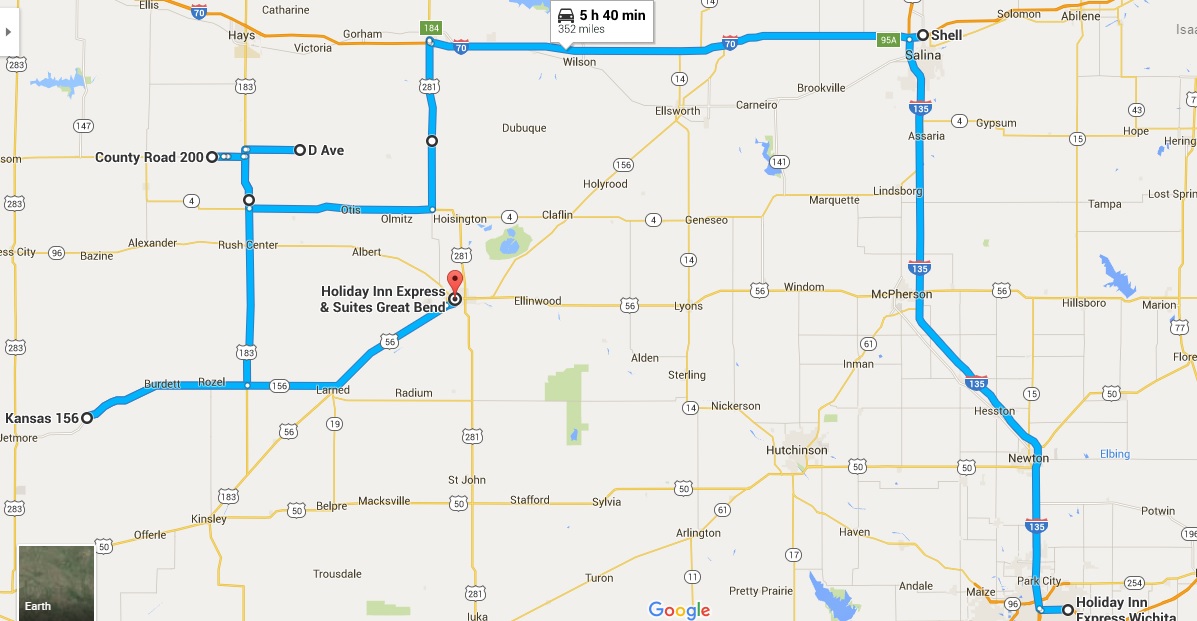
Today's route map. An interactive version is available below

Today’s route map. An interactive version is available below

Models indicated this morning that a much deeper surface low would coalesce by the afternoon as a shortwave ejected northeastward along an upper-level trough. This low would be the deepest and most organized of the trip, and as a result the most well-defined warm front of the trip would be in play. These warm fronts are important because, like weaker outflow boundaries, they provide an axis along which low-level winds back and improve the overall shear profile. This warm front would provide a more focused area for rotating supercell and tornado development. Since the surface low was expected in southwest Kansas by the afternoon,  the warm front was expected to drape along the Nebraska-Kansas border, and our target was north central Kansas. We decided to move to Salina for another look at data and make futher decisions about our target.

11 AM CST mesoanalyses and radar analysis combined with surface observations indicated clear mositure wrapping from the south counterclockwise around the low through north central Kansas. The axis of this moisture wrapping was centered on Ellsworth, KS. The 11:30 SPC convective outlook update upgraded central Kansas to a moderate risk with a 15% chance of tornadoes and a 10% chance of EF-2 TO EF-5 tornadoes. Satellite and radar observations indicated boundary interaction near Russel, KS. We targeted that city and moved to wait for initiation.

12:30 PM CST initiation in southwest Kansas outside of our target area quickly became messy and numerous due to a very weak cap over the region. This brought concerns for our target area, as early convection could stabilize the atmosphere enough that later convection could struggle to initiatie. We became uncertain about the severity of the day, which turned out to be warranted.

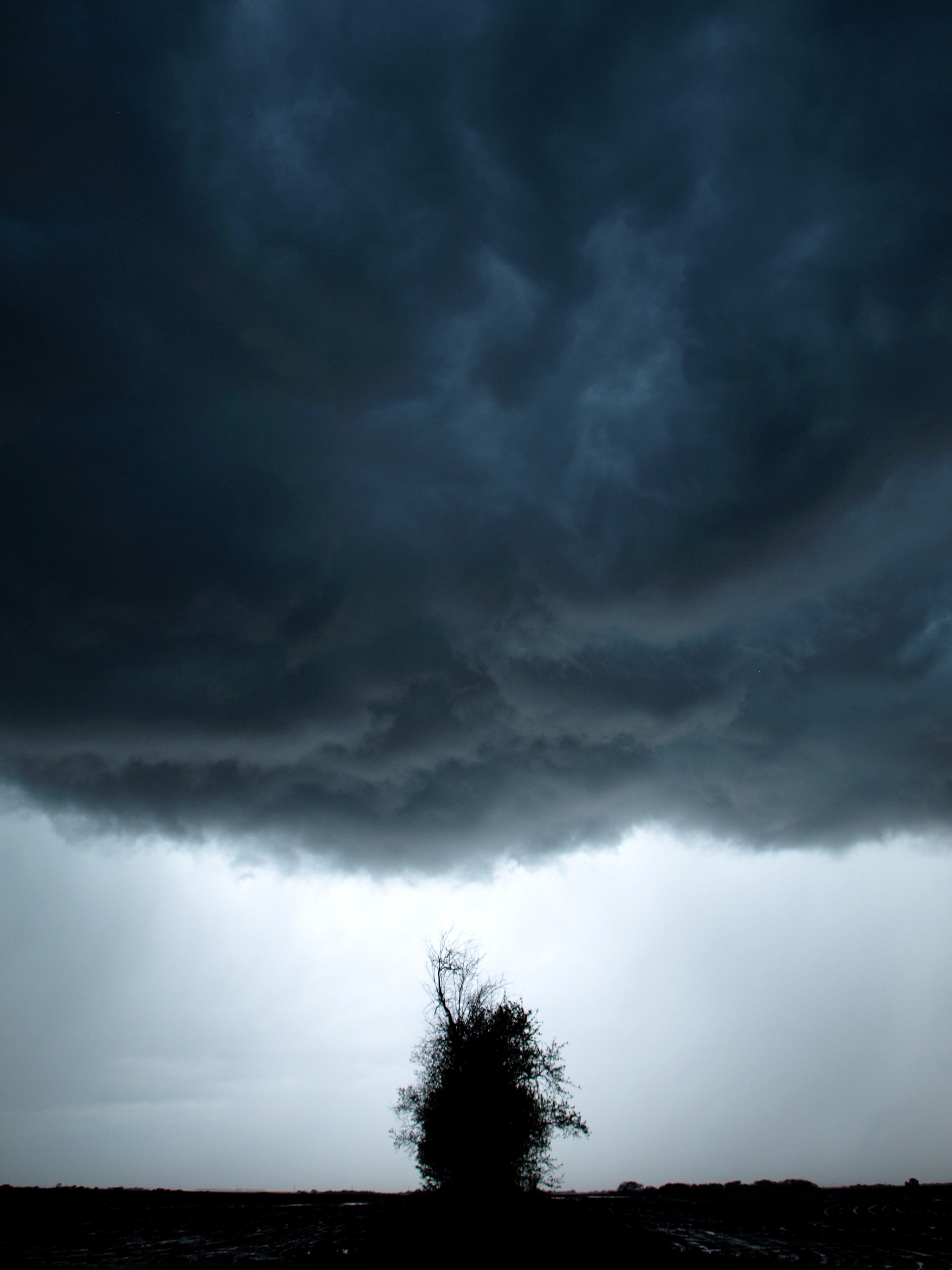
We decided to intercept a storm just north of Jetmore that had initated to the southwest of the target region. We chose this storm because the larger storms to the south were entering a cloudy environment that convection had already been present in. The Jetmore cell was entering a clear area, and was closer to the boundary so better shear was present. The storm ended up fizzling, but the larger storms to the south were moving north into a boundary, so we moved ahead of them to attempt an intercept, even thought the storms were non-rotational. Road conditions quickly deteriorated, and we were left with no clear escape route. The storm’s shelf cloud overtook us (Figure 1), and we got deluged on.

Figure 1: A shelf cloud overtakes the van in Otis, KS

Figure 1: A shelf cloud overtakes the van in Otis, KS

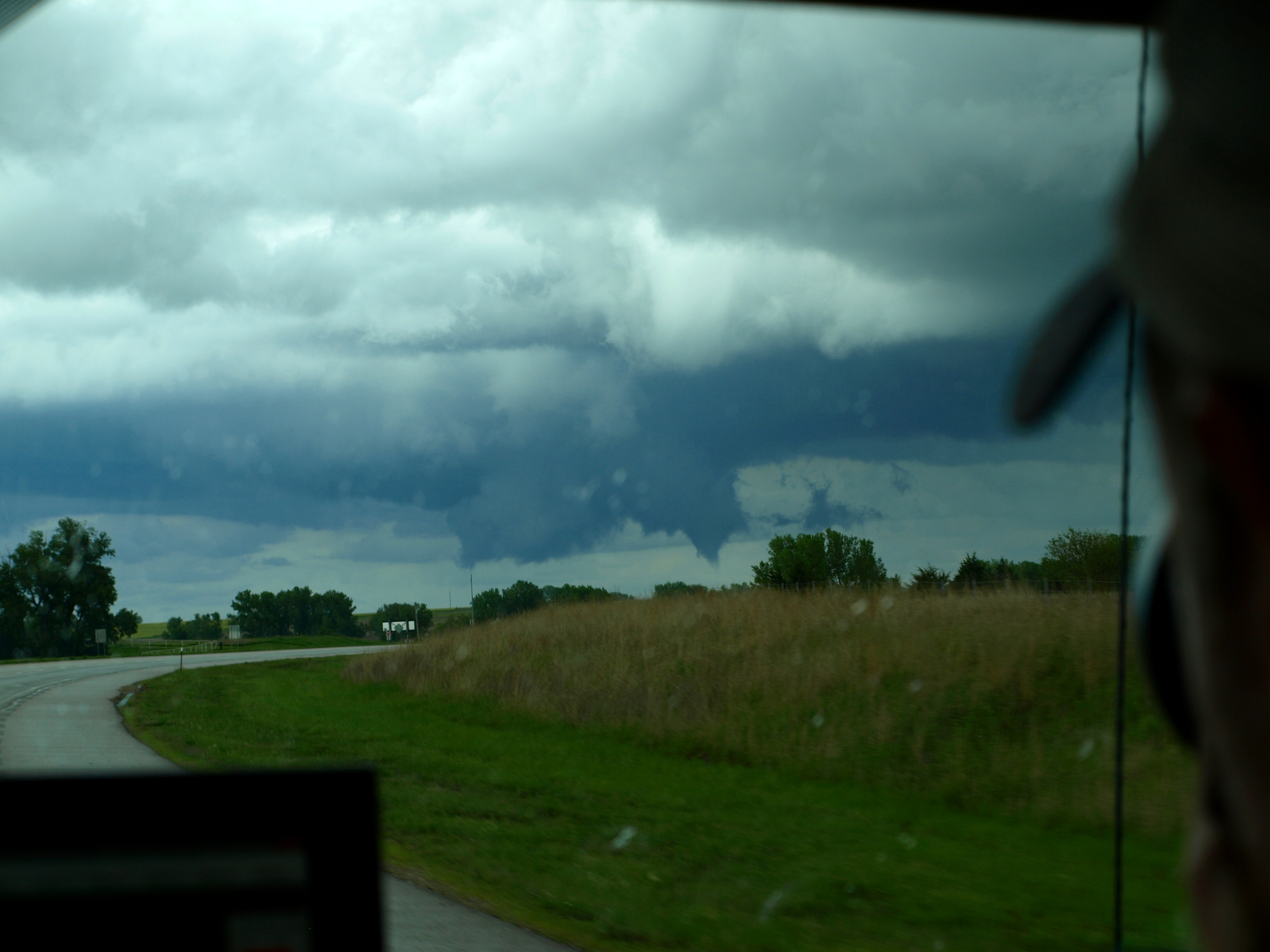
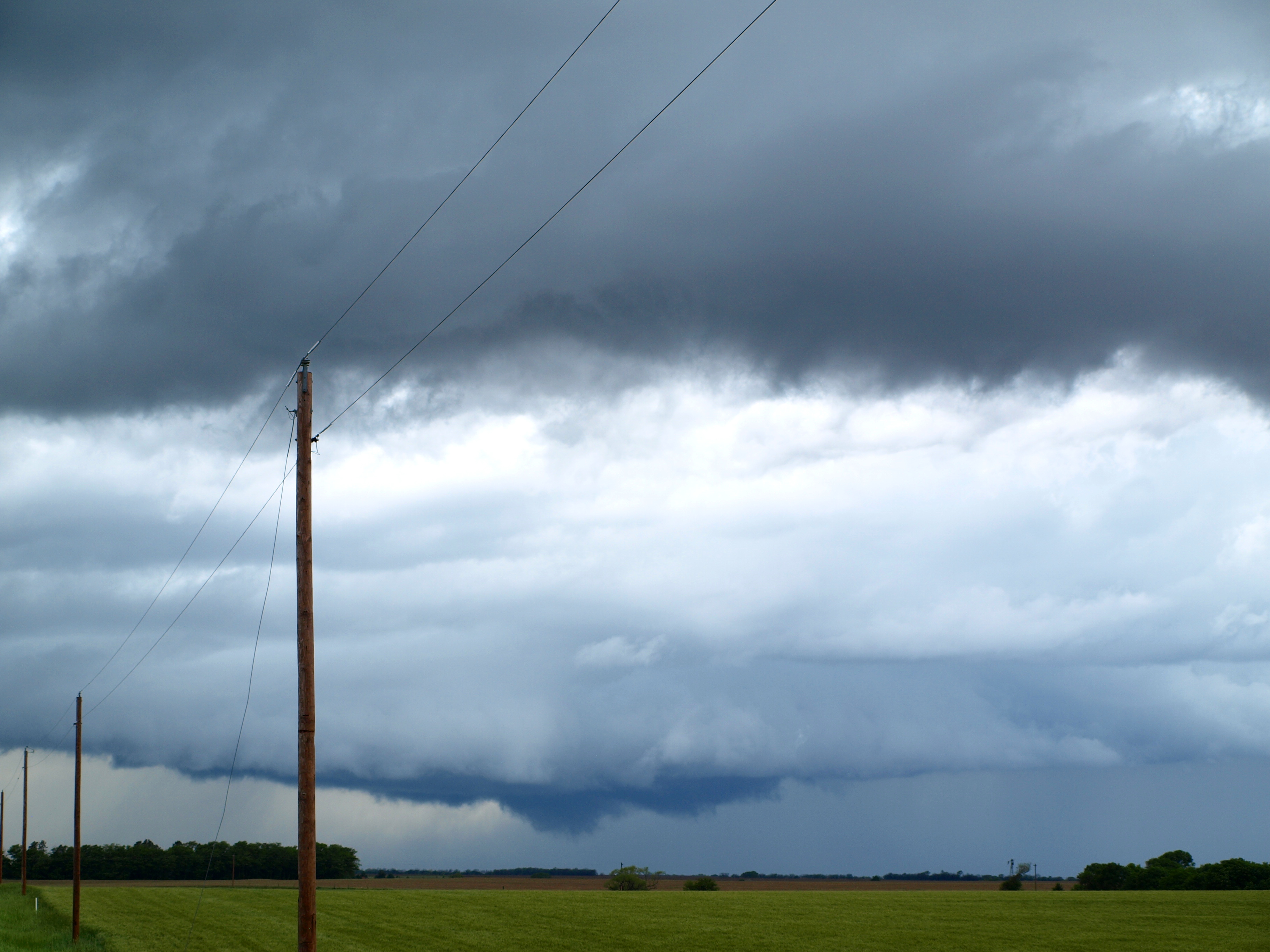
After the storm weakened, we stopped in Hoisington, KS to decide what to do. It seemed that the incredibly messy convection and low shear were causing this day to become unchaseable, and we nearly called a scrub. One cell near Dodge City, where outflow and dryline convergence had produced more organized storms, gave us hope however, and we moved to intercept. Intercept occurred in Hanston, KS, where the storm showed us the closest thing to a tornado we had seen all day (Figure 2) when she showed us a lowered rotating wall cloud. The storm was tornado warned for about 15 minutes, and then lost rotation as it merged with other cells and became a QLCS (quasi-linear convective system).

Figure 2: A lowered, rotating wall cloud is visible on the far right. Taken looking south from Hanston, KS

Figure 2: A lowered, rotating wall cloud is visible on the far right. Taken looking south from Hanston, KS

We raced ahead of the squall line to our hotel in Great Bend, the same hotel we stayed at just two nights ago, and made it there just in time.

We appear to be very close to our target tomorrow in central Kansas, although the passing of the shortwave trough that created today’s low will create some downward motion of the atmosphere which may inhibit strong updrafts.

-Isaac Bowers

Click this link for an interactive chase map!


Posted in U.S. Weather | Tagged , , , | Comments Off on WKU Storm Chase 2016 – Day 12

WKU Storm Chase 2016 – Day 11

Today;s route map. An interactive version is available below

Today’s route map. An interactive version is available below

Much weaker low pressure and the presence of much weaker and more diffuse boundaries meant today would likely be a slow day for storms across our target region, although instability and mid-level shear would be enough to support supercell development in any updrafts that were capable of breaking the moderate cap. Tornado risk was much lower today due to the aforementioned lack of a strong outflow boundary/warm front that would back low-level winds. However, the boundaries that did exist seemed to converge near Salina, KS, and we targeted that location for initiation. Low expectations and proximity to the target region meant a late start, and we departed Great Bend, KS at 10:30 AM CST.

En route to Salina, the SPC upgraded nearly the entirety of eastern Kansas to a slight risk as model data indicated an expected bulge in the dryline just south of the low pressure center. The convergence provided by this boundary may support sufficient lift to initiate supercells that would thrive in the unstable environment ahead of the dryline.

After lunch at the Cozy Inn in Salina, KS, 3 PM satellite and surface analysis indicated that a strange double-boundary was setting up, pushing our target either north or south to two separate dryline/boundary interaction points. We chose the southern target, and moved to Florence, KS to make further decisions.

Initiation occurred southeast of Wichita, KS at 5:15 PM CST. It appeared unimpressive on radar, but it was the only cell in the area that fired, so we moved to intercept. In El Dorado at 5:45 PM We viewed the storm as an impressive updraft formed (Figure 1), but the updraft was thin, and as we chased it became entrained and was choked off (Figure 2). It was believed the storm could have been over-sheared.

Figure 1: An impressive updraft on the El Dorado cell

Figure 1: An impressive updraft on the El Dorado cell

Figure 2: The El Dorado cell chokes itself off

Figure 2: The El Dorado cell chokes itself off

After calling the chase and on our way back to Wichita for the night, an interesting supercell formed to the southeast of the city. Again, it appeared unimpressive, but it was the only storm that was sustaining itself, so we decided to investigate. Upon intercept, the storm remained unimpressive on radar and was non-rotational (although the naked eye could see some rotation in the lowered base), but it did provide some impressive sunset views.

Convergence ended up being better at the northern bulge, closer to the low. A tornadic supercell was spawned near Bennington KS. Surprisingly, convection struggled to sustain itself in the southern environment. This was again likely due to a weaker boundary than the northern target zone.

Tomorrow a classic baroclinic low will set up in western Kansas, providing a much higher risk for severe weather across central Kansas. It should be an active day!

-Isaac Bowers

Click this link for an interactive chase map!

Posted in U.S. Weather | Tagged , , , | Comments Off on WKU Storm Chase 2016 – Day 11

WKU Storm Chase 2016 – Day 10

Today's route map. An interactive version is available below.

Today’s route map. An interactive version is available below.

Words cannot describe the feelings I experienced today.

I could say I was awe-inspired, and it would not be enough. I could say I was terrified, and it would not be enough. I could say I was exhilarated, and it would not be enough.

So much happened today that it was difficult to keep track of every event, but I will try my best to recount today’s remarkable journey.

Another weak surface low developed overnight in southwest Kansas in a similar setup to yesterday. The upper-level trough was parked over the Mountain West, and continued providing almost daily ejections of vorticity and wind speed maxima into the central and southern Plains. This low again provided an anchor for the dryline that draped southward across west Texas, as well as some low-level convergence needed for lift. This low however lacked a clear warm front, which would have encouraged low-level shear by backing the winds near and along it. This problem was solved by yet another outflow boundary from an MCS in Kansas that stretched west-to-east across southern Kansas in the morning. We forecasted that this outflow boundary would be pushed north in the afternoon to align with the low pressure system and act as a warm front in this environment. Our target was where we thought this “triple point” of low pressure, dryline, and outflow boundary would align; southwest Kansas, specifically Greensburg for initiation.

It should be noted that this environment is an extremely similar setup to yesterday, so we were initially wary of being overzealous.

We had lunch in Greensburg and a 1 PM CST analysis of satellite imagery showed that the placement of the dryline and outflow boundary pushed our target to the south and west. We decided to move to Meade, KS and wait for initiation. We tossed a Frisbee in Meade City Park until around 4:15 PM CST, when we believed that the only tornado of the day would be located in Scott City, KS. As we moved north, it was noted that directly overtop of Meade, a large convective updraft had fired and was growing quickly. We turned around to intercept in Minneola, KS. This was a decision that shaped our entire day.

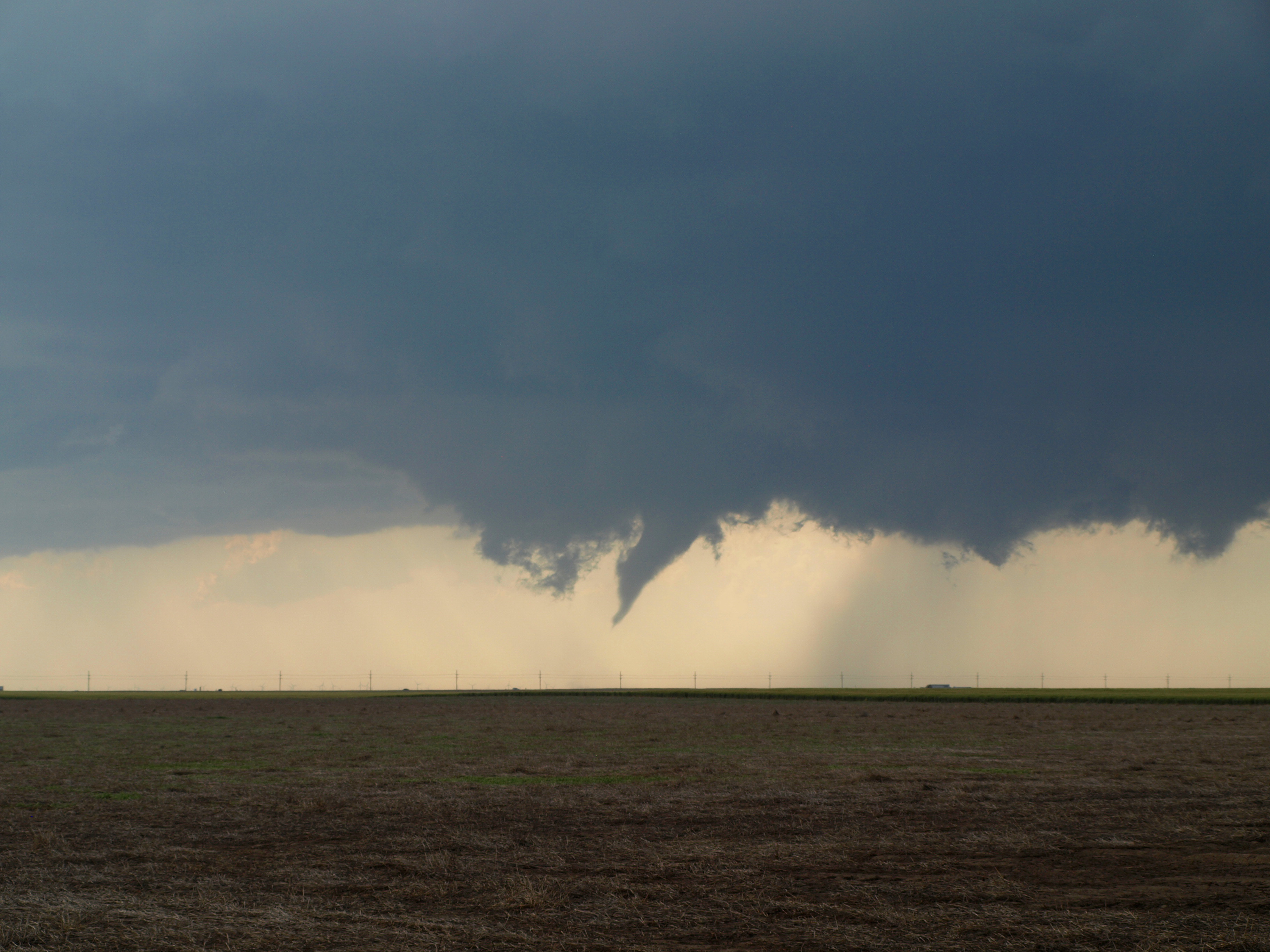
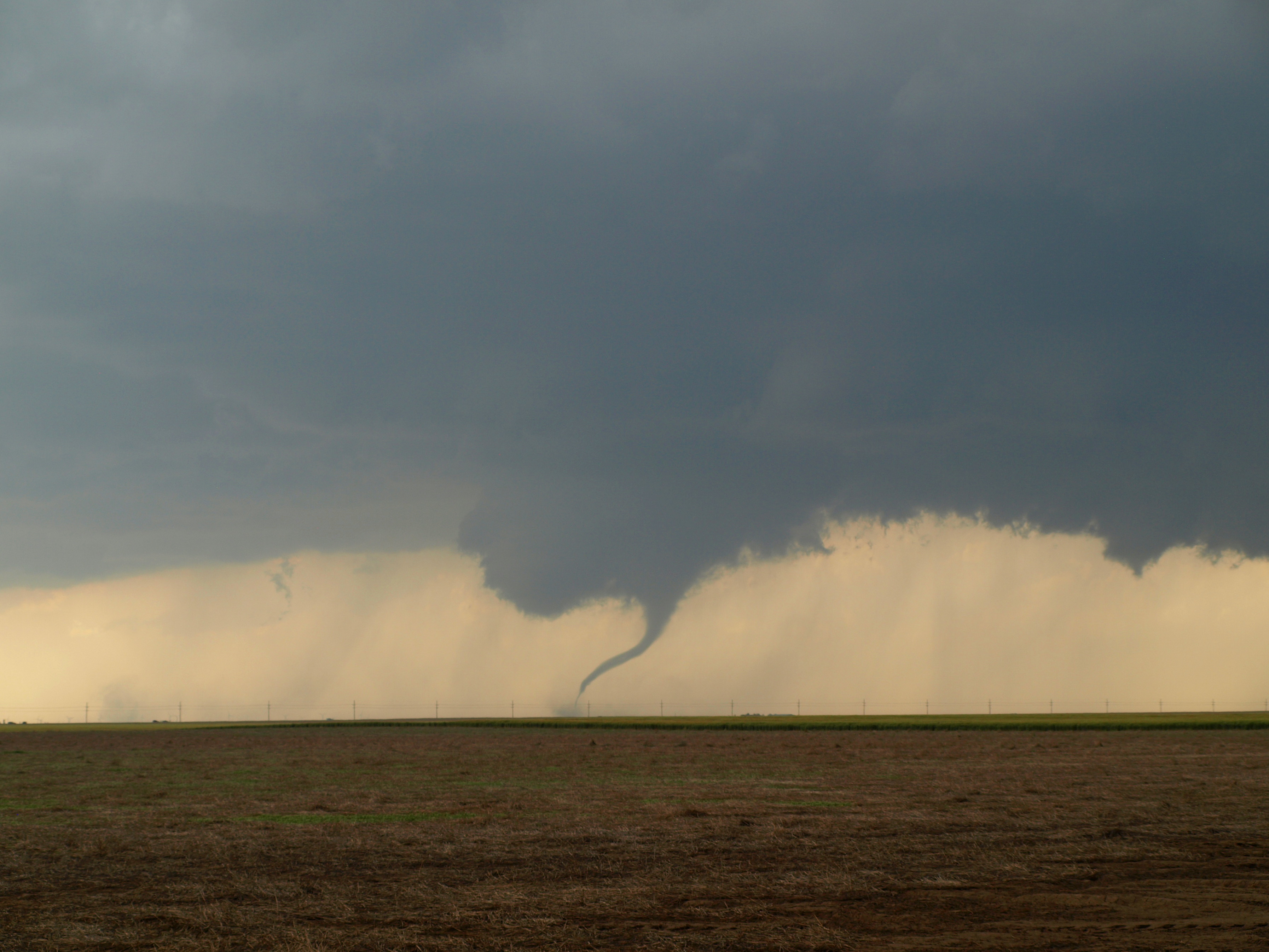
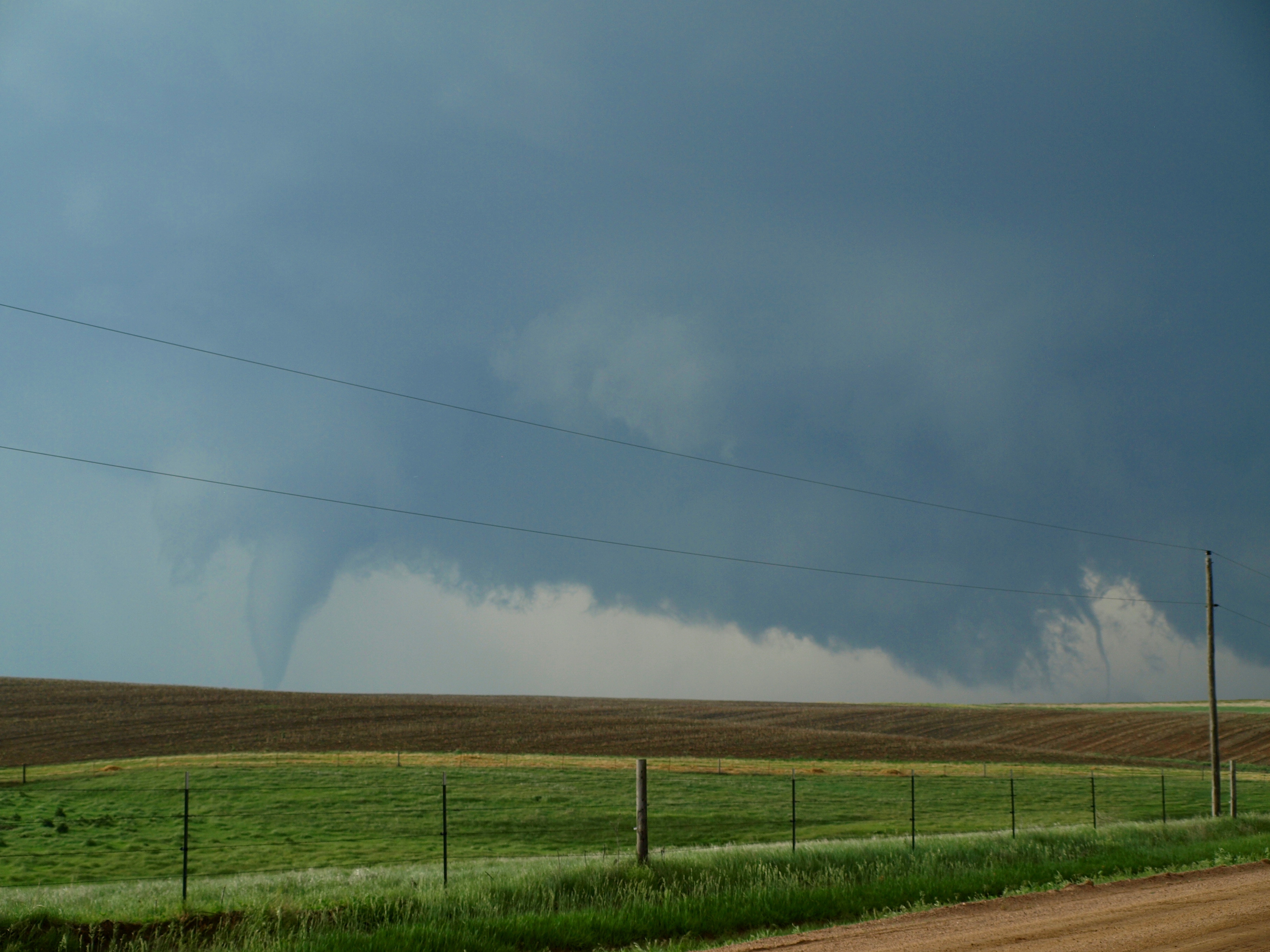
Very quickly it became apparent that this cell was taking advantage of the abundant low-level shear, as the base quickly lowered and began rotating. We were able to watch as the updraft lowered a funnel in front of our eyes (Figure 1). The sheer speed that the column was rotating was incredible to us, and we were able to watch clouds lift and form just feet from the ground. We rooted on our little funnel as it twisted over the empty fields of Kansas.
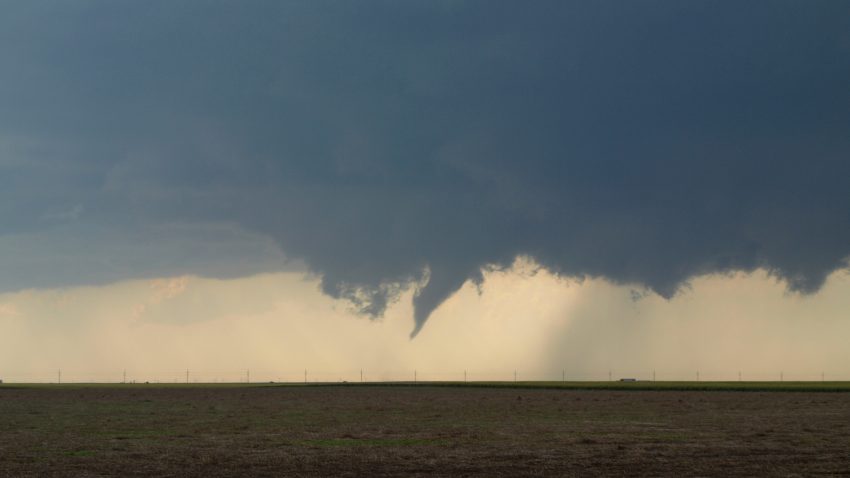
Figure 1: The Minneola supercell drops a funnel

Figure 1: The Minneola supercell drops a funnel

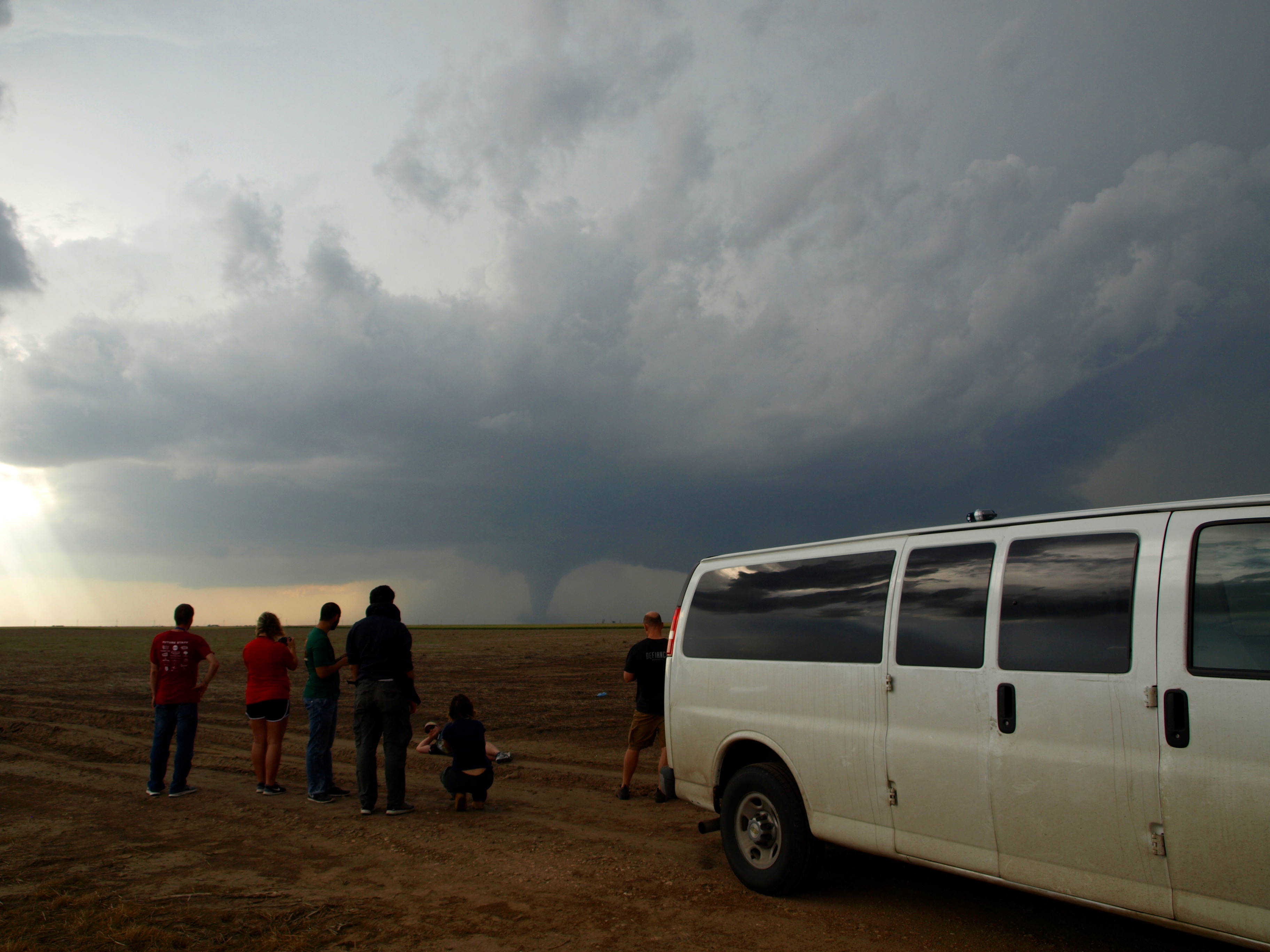
The funnel touched down briefly at first, kicking up dust circulation near the ground. It then planted itself firmly and became a full fledged tornado, and grew in size from a small rope to a thick cord and larger (Figures 2 and 3). The giddiness of seeing this awesome structure became tainted with a small amount of fear. This destructive force was growing unchecked. What was a fun, cute rope tornado was now looking like an EF-1 and strengthening. As we chased the storm north, the first funnel withdrew and roped away, but it was the first of many tornadoes that day.
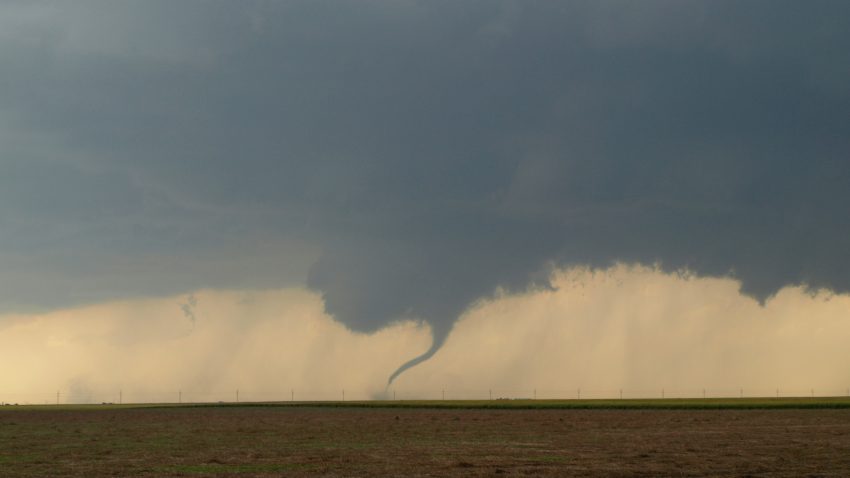
Figure 2: A rope tornado forms from the Minneola cell
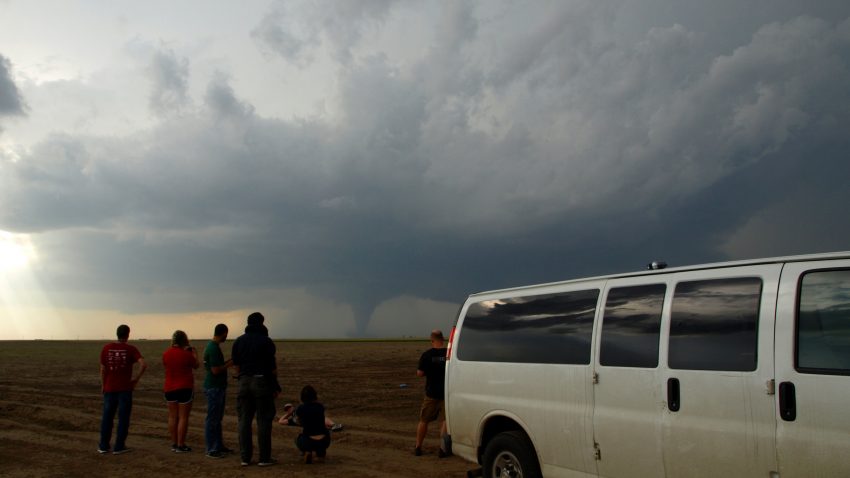
Figure 2: A rope tornado forms from the Minneola cell

Figure 3: WKU students watch as the Minneola tornado intensifies

Figure 3: WKU students watch as the Minneola tornado intensifies

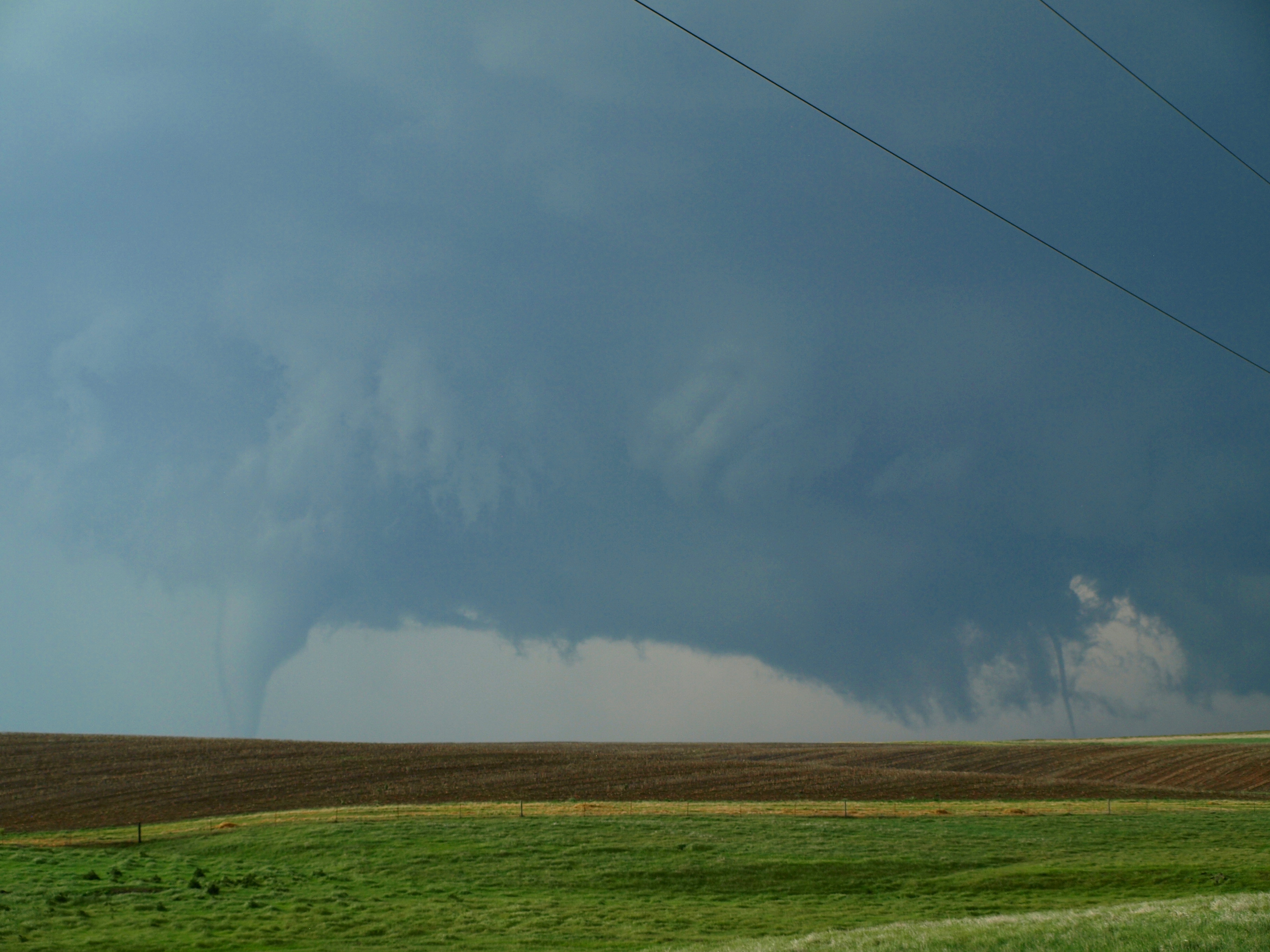
We watched the storm cycle through two to three more independent touchdowns as we chased, one occurring simultaneously. When we next stopped, a large funnel, the 4th of the storm by our count, had slid up the base and the storm was again going through vortex cycling (Figure 4). In seconds, the storm threw down two twin rope tornadoes, and the storm had three tornadoes on the ground at once (Figure 5). Never before had I experienced whatever emotion I felt in that moment This storm that contained three tornadoes was headed directly for Dodge City. My adrenaline was roaring, and recognition of this storm’s incredible power really resonated for the first time. This was obviously something incredibly special and incredibly dangerous.
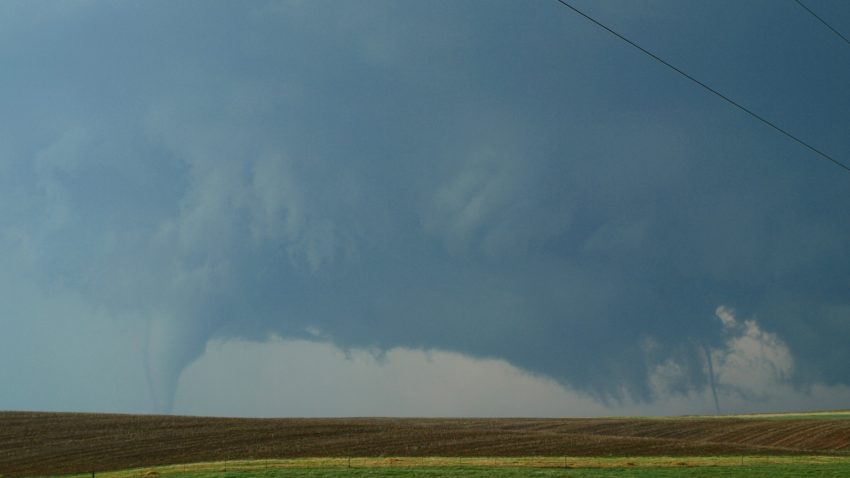
Figure 4: The supercell undergoes vortex cycling southwest of Dodge City. Two tornadoes are visible at once
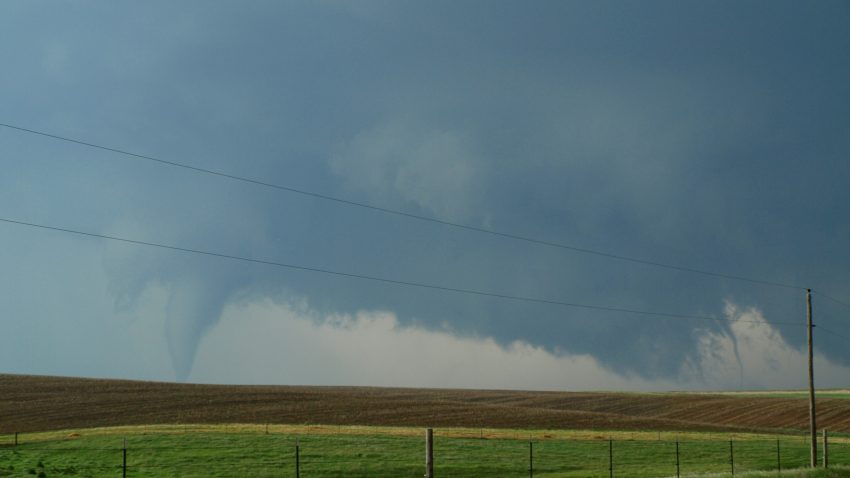
Figure 4: The supercell undergoes vortex cycling southwest of Dodge City. Two tornadoes are visible at once

Figure 5: The lower vortex becomes multi-vortexed, dropping sister tornadoes. Three tornadoes are visible on the ground

Figure 5: The lower vortex becomes multi-vortexed, dropping sister tornadoes. Three tornadoes are visible on the ground

After 9 visible tornado touchdowns and quickly deteriorating road conditions became a problem (Kansas dirt turns to Kansas mud very quickly), we decided to escape the area, as storms to the south and west were quickly cutting off our escape route as the storm moved through west Dodge City. As we raced west on the south edge of the storm, we were able to view some damage in the storm’s path. Power lines had been completely ripped from their bases and were no longer at the side of the road, having been carried by the winds to the middle of some far-off field. Fences had been ripped from their posts. Heavy rain and hail from a ventilating storm to our south blocked our view of some power lines that were hanging mere feet from the road, almost until it was too late. A powerful downdraft pushed a semi-truck into the oncoming lane, and we had to swerve to narrowly avoid it. (A large thanks goes to Dr. Durkee for saving our lives).

We passed through Cimarron, KS where we learned that both roads east into Dodge City had been closed, so we proceeded north and east to our hotel in Great Bend, KS. We stopped to show that beauty can be found even in the most violent of situations (Figure 6).
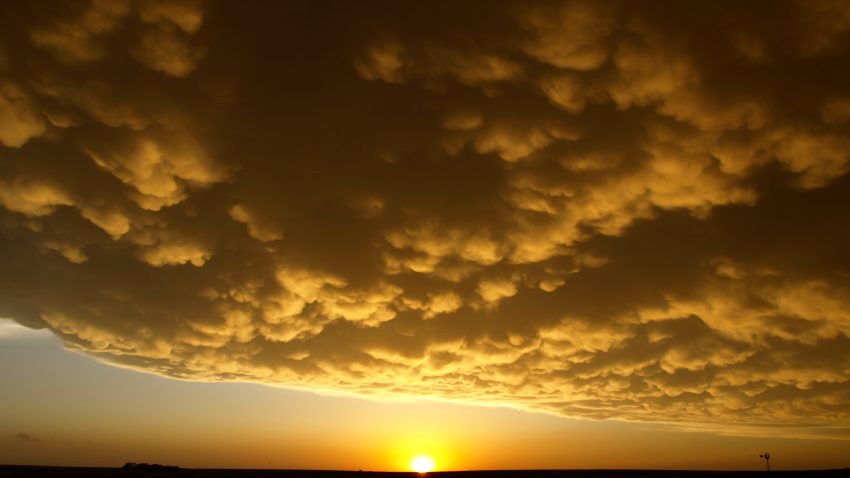
Figure 6: Mammatus clouds form in the wake of the violent supercell

Figure 6: Mammatus clouds form in the wake of the violent supercell

Today proved to me just how important an understanding of meteorology is to our society, and how nature can be as beautiful as it is destructive. The feelings I felt today are feelings I believe I will never feel again. I trembled as we left that storm, and I still feel the power of it this evening. I know I speak for all of the students when I say that this is a day we will remember forever.

-Isaac Bowers

Click this link for an interactive chase map!
Posted in U.S. Weather | Tagged , , , , | Comments Off on WKU Storm Chase 2016 – Day 10

WKU Storm Chase 2016 – Day 9

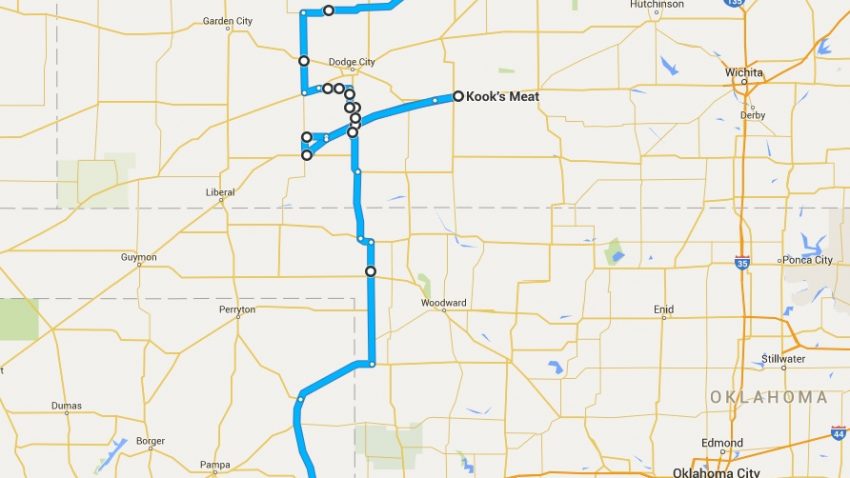
Today's route map. An interactive version is available below

Today’s route map. An interactive version is available below

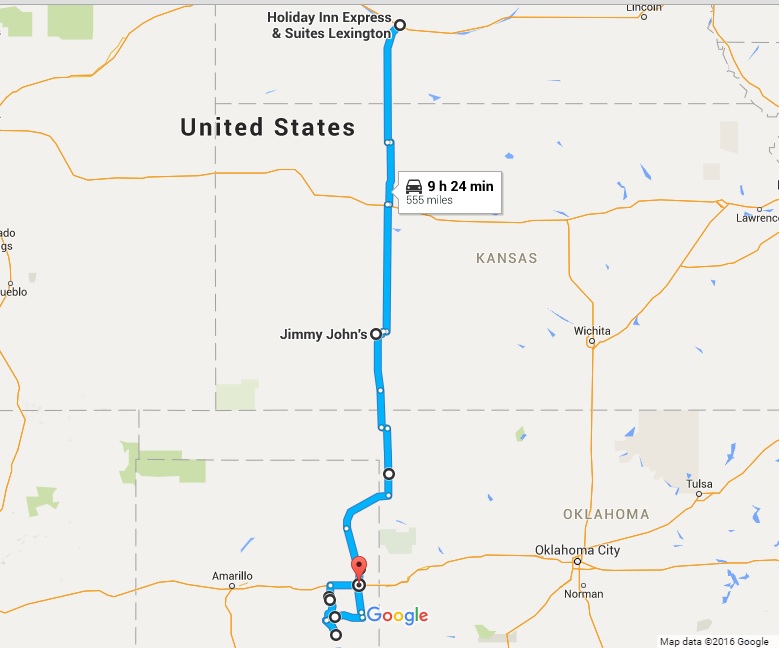
Morning observations identified a weak surface low over the extreme western Oklahoma Panhandle as a result of a shortwave trough rotating through the region that would provide some convergence and an anchor for the dryline draped in a southwest-northeast fashion across the Panhandle region. Model data indicated that CAPE values would reach the 4-5000 J/kg range by mid-afternoon, and steep low-level lapse rates would advect into the area as well. Ample moisture and weak capping in this environment indicated strong updrafts would be possible capable of producing severe hail. Bulk shear values between 35 and 45 knots that would increase throughout the day pointed to the likelihood of supercells capable of producing tornadoes. A convective outflow boundary from an MCS (mesoscale convective system) moving out of central Oklahoma would cross into Texas by early afternoon, and would provide an area of enhanced shear due to the forced backing of the low-level wind profile along this boundary. We decided to target the southeast Texas Panhandle for initiation; specifically Clarendon, TX. Due to the distance of the target from our Nebraska hotel, an early start  of 8:30 AM CST was required, and it was uncertain if we would even make it to Clarendon by initiation hour.

10 AM CST SPC Mesoanalysis indicated decent low-level shear and Effective SRH (storm relative helicity) maximums in the 400’s already in place over the target region. This caused STP’s (significant tornado parameter) to rise above 2 over the target area before daytime heating even occurred, which was very impressive. By 2:30 PM CST, model guidance and mesoanalyses began aligning and agreeing on the southeast Texas Panhandle for the best chance of tornadic supercells. Inititation took place around 3:40 PM CST less than 5 miles east of Clarendon, TX, a bullseye hit on our target selection. We were still about 40 miles away, so we changed route to intercept the storm south of Shamrock, TX.

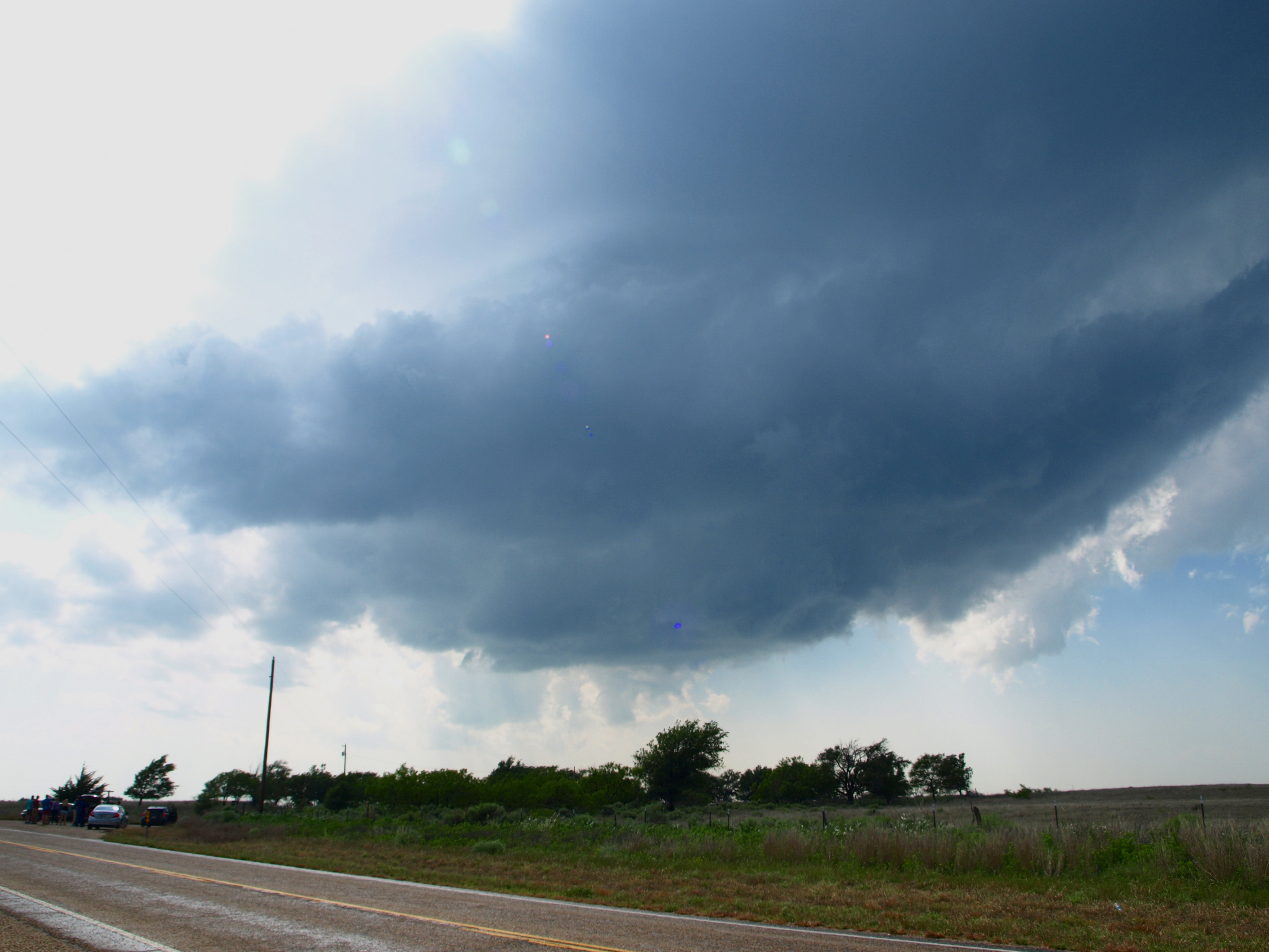
We intercepted the LP (low precipitation) supercell east of Clarendon, which began entering a mildly capped environment shortly after we arrived (Figure 1). Although the structure was impressive, it was very similar to storms we chased yesterday in Nebraska, so we opted to move to better looking storms to the southwest. As we made our way there, all other initiated cells seemed to once again struggle when moving east away from the dryline. The SPC offered the possible explanation of a lack of low-level convergence in this area, but with storms already initiated, it seemed that they should be able to support themselves in such a rich environment. We began scratching our heads once again in Memphis, TX as we waited for a better cell to organize.

Figure 1: The Clarendon cell disintegrates shortly after initiation

Figure 1: The Clarendon cell disintegrates shortly after initiation

With daylight fading, we began a last ditch effort to chase a cluster of storms developing west of Memphis. As we chased, the cell south of Alanreed, TX began to show signs of rotation and a hook echo. We changed our route to intercept the storm since it was the best looking in the cluster. On our way there, we decided to take a questionable road (County Road E on the map) to get a better look at the storm. We had to turn around when it got too muddy, and as we tried successfully to 100-point-turn our way out, a TVS appeared on radar, and reports of a brief weak tornado over nearby I-40 also appeared. We returned to a higher quality road and viewed the nearly stationary storm from an excellent vantage point, but never viewed another funnel from the storm (Figure 2).

Figure 2: Post-tornadic cell beginning to shear its own updraft off

Figure 2: Post-tornadic cell beginning to shear its own updraft off

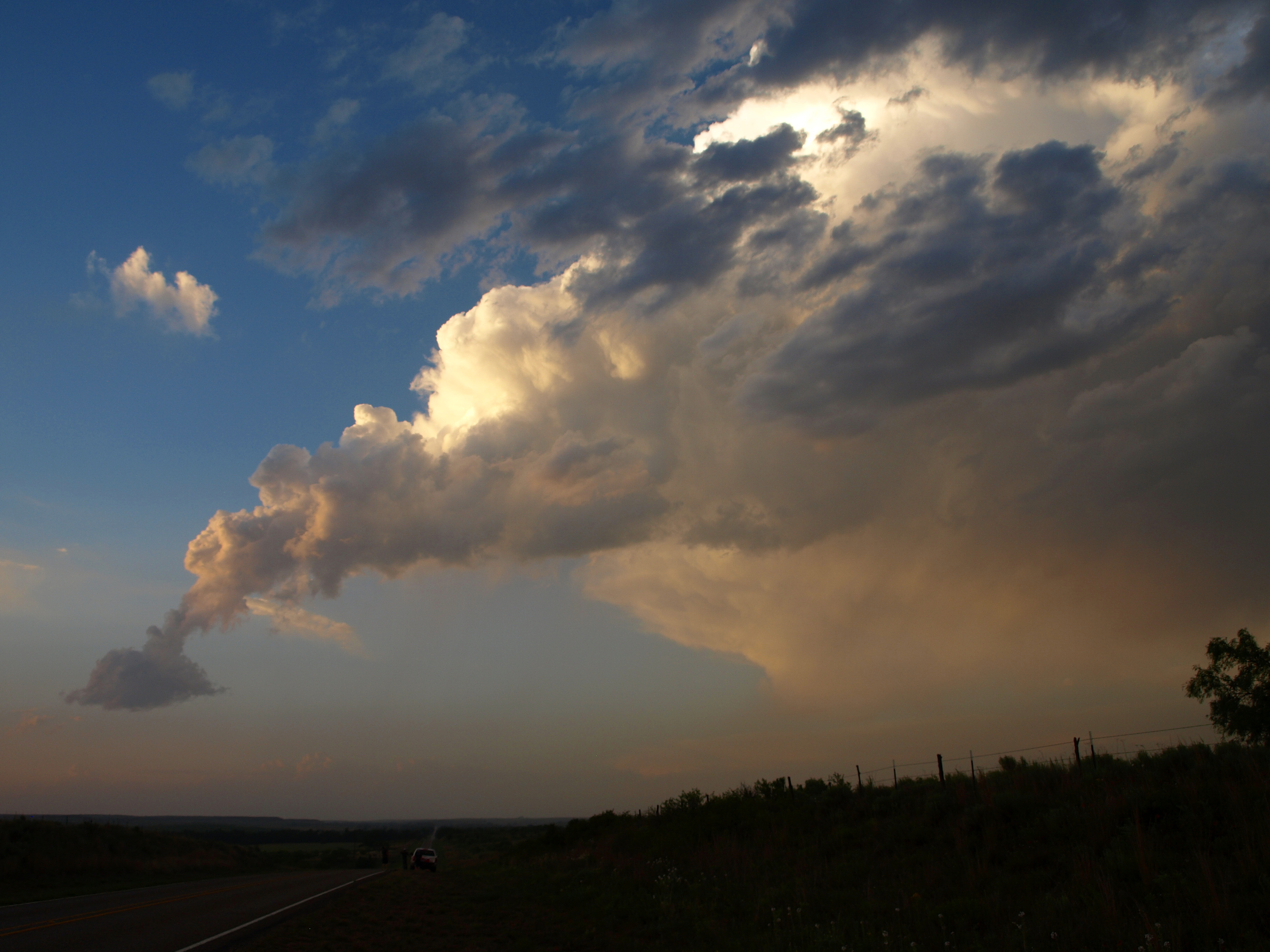
The storm eventually twisted its own updraft off in a similar fashion to yesterday’s storms as it entered a more stable environment to the west, but it looked remarkably unusual. The updraft seemed to feed a much larger area of downwind precipitation than it could support for its size, and it appeared to twist and rope away from a far-away and miniscule inflow base (Figures 3 and 4). It was a structure I’ll never forget.

Figure 3: The updraft begins twisting itself off. The rotation is clearly visible.

Figure 3: The updraft begins twisting itself off. The rotation is clearly visible.

Figure 4: The updraft completely separates from its cloud base.

Figure 4: The updraft completely separates from its cloud base.

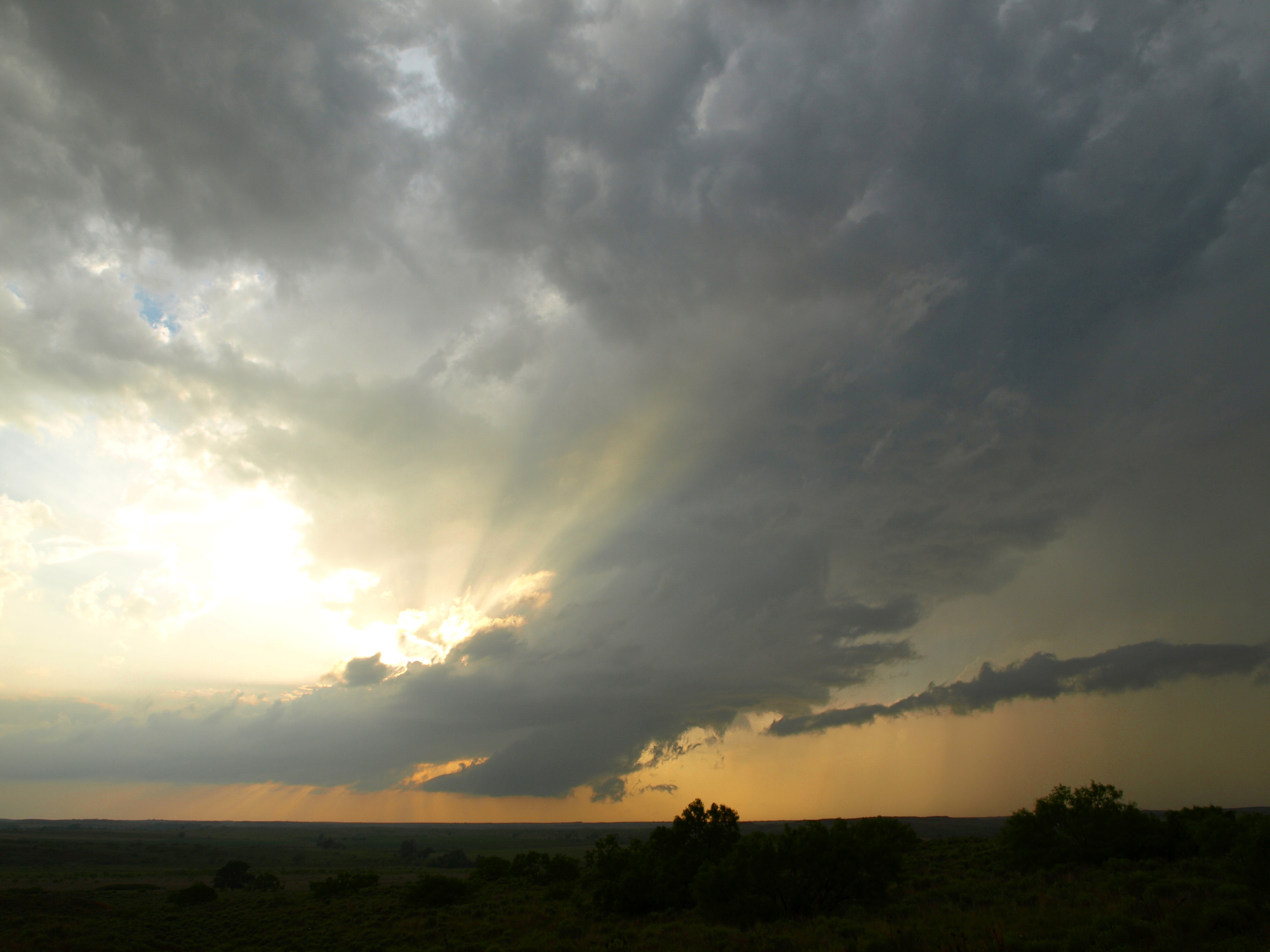
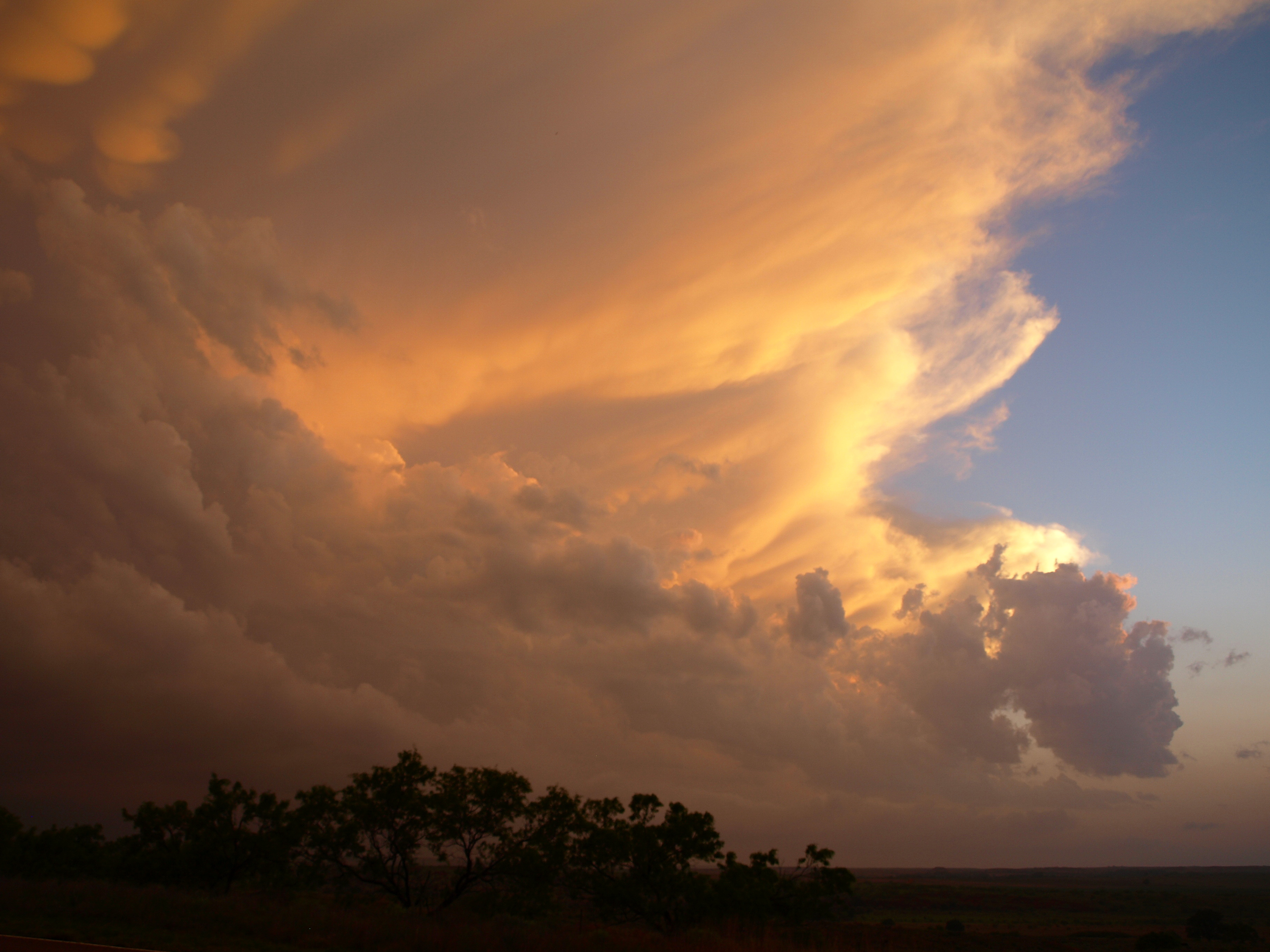
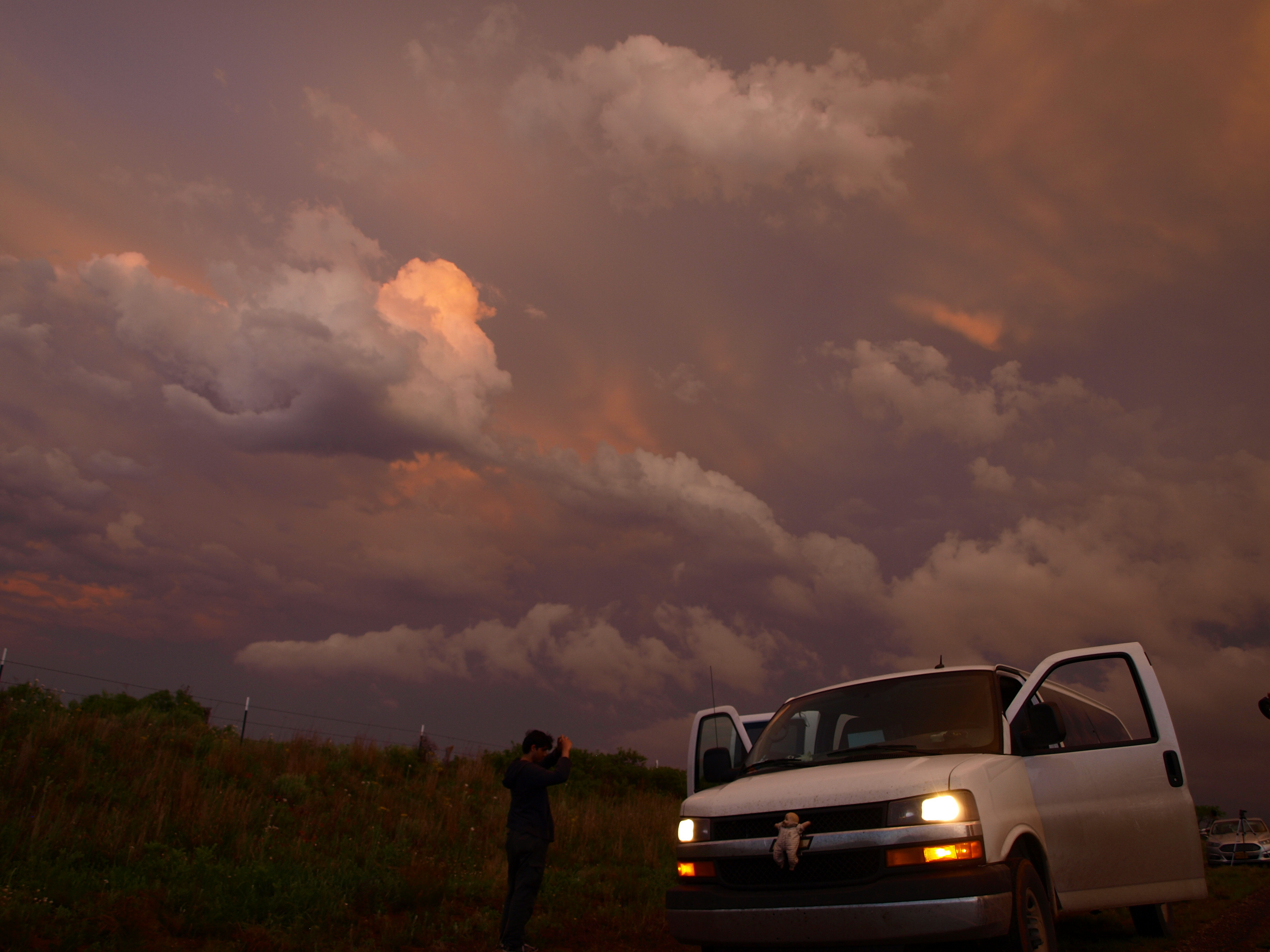
The sun set shortly after the tornadic storm dissipated, and we were able to take some excellent photographs of a supercell to our south whose colors were so vivid they barely needed to be edited (Figures 5 and 6). We proceeded to our hotel in Shamrock, TX for the night.

Figure 4: A vivid sunset lights up a southern supercell

Figure 5: A vivid sunset lights up a southern supercell

Figure 6: Sunset on the van

Figure 6: Sunset on the van

Hopefully Shamrock can provide us with some luck as we proceed north and east to chase tomorrow!

In addition, one of our students, Lucas Cantos, took several time-lapse videos of our amazing structure day in Leoti, KS on Saturday. They are some epic glimpses at the storm’s motion, so follow this link to have a look.

-Isaac Bowers

Click this link for an interactive chase map!


Posted in U.S. Weather | Tagged , , , , , , | Comments Off on WKU Storm Chase 2016 – Day 9